From centralized to matrix: designing an operating model with clear P&L owners
Who owns the number? An operating model with clear P&L owners and decision rights.
Every marketing team that grows past one brand or one market runs into the same question sooner or later: who owns the number?
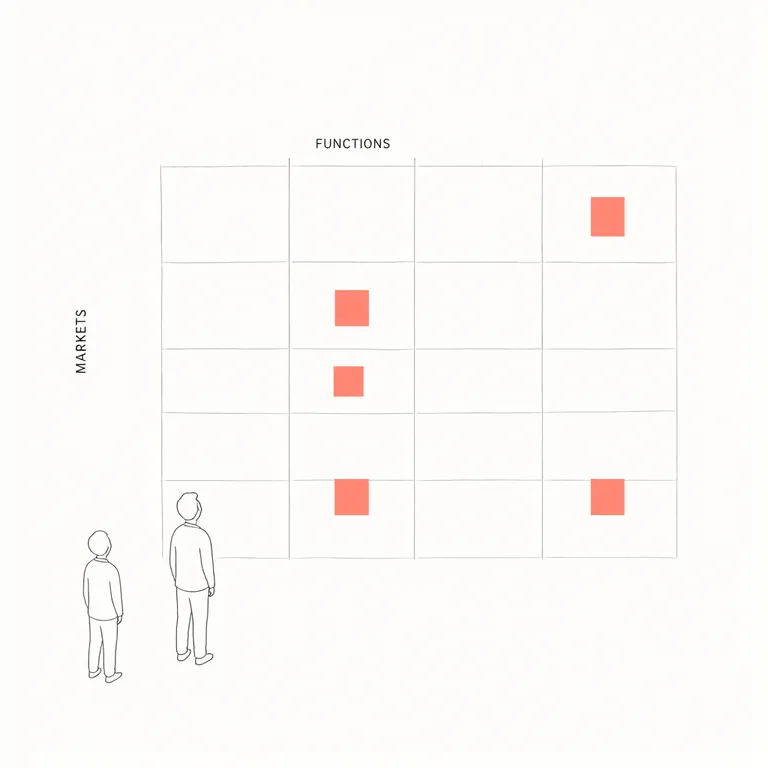
Decisions move when it is clear. When it’s not, you get duplicated reporting, budget arguments that go round in circles, and a campaign that waits two weeks because three people think they have the final say. In this article, I'll walk through the three basic operating models, why so many companies end up in a matrix, and what it takes to make one work, using a model I designed in my own career as the example.
Three models with three trade-offs
There is no perfect structure but only trade-offs. Here are the three you'll meet most often:
| Model | How it works | What it's good at | Where it hurts |
|---|---|---|---|
| Centralised | One central team runs strategy, brand, media and production for every market and brand | Consistency, scale, shared tools, lower cost | Slow to react locally; markets feel like customers of a service desk |
| Decentralised | Each market or brand runs its own marketing, with its own team and budget | Speed, local knowledge, clear ownership | Duplicated work and tools; brand drift; hard to share learnings |
| Matrix | People report along two lines, for example to a market or brand owner and to a central function such as performance, creative or analytics | Local ownership with shared expertise and scale | Blurred accountability; more meetings; conflict over priorities |
Most companies drift towards a matrix for a good reason. Jay Galbraith, one of the best-known writers on organisation design, put it simply: matrix organisations result "when two or more activities must be accomplished without hindering the other". Rather than choosing the "or", a matrix embraces the "and". Companies want to be global and local (1). In marketing, that usually means you want each market to own its growth and you want one strong brand, one data stack and one set of experts.
I lived through exactly this choice in my career. The organisation had run a centralised model for seven or eight years. Then it decided to build more products, with more funding from the board. The central team couldn't fully understand every local market, and it didn't have the capacity for the sudden jump in big strategic decisions. At the same time, there wasn't enough money to build complete local teams with both specialists and management. So leadership started to look at a matrix: local leaders in each market, still working with the central team.
I designed the marketing decision and operating model for that move, in a multi-brand organisation across several markets, with local teams close to customers and central teams holding the channel expertise. In one line: decentralised ownership, centralised execution and expertise.
Why the matrix has a bad reputation
The matrix has been criticised for almost as long as it has existed. As early as 1978, Harvard Business Review was cataloguing its "significant pathologies" (2). In 1990, Christopher Bartlett and Sumantra Ghoshal argued that many companies were "organizationally incapable of carrying out the sophisticated strategies they have developed", and that matrix management is "not a structure, a frame of mind" (3).
More recent data shows both sides. In a 2015 Gallup survey of nearly 4,000 US employees, analysed with McKinsey, 84% were matrixed to at least some degree. People in the most matrixed setups were about twice as likely as the least matrixed to say their organisation helped them collaborate and do their best work. But only a minority of them strongly agreed with "I know what is expected of me at work", against 60% of non-matrixed employees (4). The same article reports that in McKinsey's organisational health research, role clarity is one of only four management practices, out of 37, that has a direct effect on overall organisational health (4).
So the matrix gives you collaboration, but you pay in clarity, unless you design the clarity back in. That design has two parts: who owns the P&L, and who decides what.
Start with the P&L: who owns the number?
In a marketing matrix, I find it helps to separate ownership of the outcome from ownership of the craft. In the model I designed, the budget rule fit into two lines: the market owns the growth target and how much to spend in total; the market does not own how to spend it in each channel.
That gave four roles, each with a clear job:
- The country general manager (GM) owns the country's total budget and its results, including the trade-offs inside the market.
- The country marketing manager (CMM) owns the country's total marketing budget, the growth target and the split between strategic and tactical channels.
- The central channel heads (Growth, CRM, Affiliate, GEO and other channels) own the channel budgets. They decide the channel logic and how specialists are allocated, protect the health of their channels, and bring expertise and insight to the markets.
- The group CMO sets the guardrails. They break ties, rebalance across markets and protect group return on investment.
This split avoids the most common matrix failure, where two people believe they own the same number. The market owns the target and the total spend; the channel head owns how that spend is used to reach the target. When two markets compete for the same money, nobody has to win the argument locally, because cross-market trade-offs sit with the CMO by design.
For the marketing KPIs, I used five: employee engagement, marketing efficiency (return on ad spend, or ROAS), retention share, brand metrics and AI adoption in marketing. Each one was calculated against the budget, so the targets and the money stayed aligned.
How the money flows
Ownership on paper only works if the planning process follows it. In my model, the everyday budget cycle ran between three parties:
- Finance sets the frame. It provides the template, timeline, baseline and run-rate assumptions, and gives each market a budget envelope with guardrails.
- The market sets the ambition. The CMM sets the strategic and tactical growth ambition and opens the discussion with the channel heads, sharing the growth target and the channel mix.
- The channel heads propose how. They come back with a channel strategy, a budget proposal and the expected impact, and say whether the ambition fits the budget.
- The market signs off. The CMM checks the plan against the local marketing strategy, challenges it, signs it off and consolidates the country budget back to finance. The channel heads then execute and optimise.
The person who owns the number signs off the plan, and the people who know the channels write it.
Make decision rights explicit
Ownership of the number is not enough. You also need to agree who makes which decisions, because that is where most matrices get stuck. In a McKinsey survey of 1,259 executives, only 20% said their organisations excelled at decision making. Respondents who said decisions were made at the right level, which often meant pushing them down, were 6.8 times more likely to be at a company the researchers classed as a decision-making winner (5).
The best-known tool is a RACI chart: for each decision, you name who is Responsible, Accountable, Consulted and Informed. The rule that matters, as the Project Management Institute puts it, is that "every task has exactly one Accountable person." When two functions both claim that seat, or both avoid it, "the fix isn't a tidier grid — it's a decision the sponsor usually has to make" (6). For bigger, contested decisions, Bain's RAPID framework separates who Recommends, Agrees, gives Input, Decides and Performs, ideally with one decider per decision (7). Bain's Paul Rogers and Marcia Blenko summed up the idea in a Harvard Business Review title: "Who has the D?" (8).
In practice, I used a lighter version with three roles per decision: who asks, owns and follows up, who answers and delivers, and who gives input or is kept informed. I split decisions into three dimensions, budget, strategy and operation, each with a one-line rule. For strategy, the market doesn't own the frameworks or playbooks, but it owns the market choices within them. For operation, the market doesn't run the specialists or direct their work, but it owns operational readiness, coordination and impact.
Here is the ownership map, generalised from the model I designed:
| Dimension | Market side owns | Central channel teams own | Group CMO owns |
|---|---|---|---|
| Budget | Total country budget (GM); marketing budget plan, growth target and strategic/tactical split (CMM) | Channel strategy and budget plan; channel execution rules; specialist allocation and prioritisation | Group guardrails and conflicts |
| Strategy | Market, local brand and go-to-market strategy (CMM) | Channel strategy; execution method, frameworks and playbooks | Group marketing strategy and brand positioning; cross-market trade-offs |
| Operation | Market coordination (CMM); operational readiness such as partners, timing and risks, and local incident handling (GM) | Execution standards and process; specialist work and delivery | Process changes and marketing OKRs |
For everyday decisions, I wrote each row as a real question someone would ask rather than an abstract category. A selection:
| Situation | Asks, owns and follows up | Answers and delivers | Gives input or is informed |
|---|---|---|---|
| Annual or quarterly market strategy | GM | CMM | Channel heads, CMO |
| Moving brand investment from one market to another | CMO | CMM | GM, channel heads |
| Local growth target and strategic/tactical mix | CMM | Channel head | GM, CMO |
| Channel budgets needed to reach the local target | Channel head | CMM | GM, CMO, finance |
| Moving budget between channels within a market (over X% goes to the CMM) | Channel head | Channel head | CMM |
| Overspend risk inside a market | CMM | Channel head | GM, CMO |
| Compliance question about targeting a customer group | Channel head | Channel head's team | CMM, legal, GM |
| Explaining a swing in local performance | CMM | CMM | Channel team |
Two details matter here. First, the owner of the number usually asks and the expert answers: if cost per conversion in a tactical channel doubles in two weeks, the CMM owns the question and the follow-up, and the channel head owns the diagnosis and the fix. Second, thresholds: a channel head can move budget between channels within a market, but a shift of more than X% goes to the CMM.
Don't try to map every decision on day one. Bain's own advice is to start with high-value or high-frequency decisions (7). In my experience the ones worth writing down first are those that get escalated more than once.
Structure is the easy part
It's tempting to think the new org chart is the operating model. It isn't. Galbraith's Star Model describes five things that have to fit together: strategy, structure, processes, rewards and people. He warned that "most design efforts invest far too much time drawing the organization chart and far too little on processes and rewards" (1).
In practice, that means four things for a marketing matrix:
- Planning and budgeting that runs along both lines. Galbraith notes that matrix organisations need "dual or multidimensional information systems" (1). If your reporting only shows results by market, channel heads can't see their impact. If it only shows results by channel, market owners can't manage their P&L.
- Shared goals. Give central teams a stake in the market owners' results, so they win when their internal customers win.
- People who can influence without authority. Galbraith's phrase is that matrix organisations need people "who can manage conflict and influence without authority" (1). Hire and develop for it.
- A regular rhythm with one owner. A short monthly forum where market owners and channel heads review results and resolve priority conflicts does more than any number of escalation rules. In my model, the meeting structure and KPI definitions sat with the CMO.
A checklist before you redesign
- Write down which outcomes each market owner is accountable for, and which numbers make up their P&L.
- Write down what each central team owns, and how it is measured.
- List the ten decisions that cause the most friction today, write each as a real question, and give it one owner who asks and follows up.
- Check that your reporting can show results both by market and by channel.
- Agree how conflicts get resolved, and set thresholds for when a decision moves up a level.
- Review the setup after six months. Decision rights drift as the business changes.
Looking back, the most useful thing I did was write the decisions down as real questions, each with one person who asks, owns and follows up. Most of the rest of the model hangs off that.
A matrix will never be as simple as a pure hierarchy. It doesn't need to be. It needs to be clear about who owns the number, who makes each call, and how the two lines work together. Get that right, and you get the local speed and the shared strength that made you choose a matrix in the first place.
References
- Galbraith, J. R. (n.d.). The Star Model. Galbraith Management Consultants. https://jaygalbraith.com/wp-content/uploads/2024/03/StarModel.pdf
- Davis, S. M., & Lawrence, P. R. (1978). Problems of matrix organizations. Harvard Business Review, 56(3). https://hbr.org/1978/05/problems-of-matrix-organizations
- Bartlett, C. A., & Ghoshal, S. (1990). Matrix management: Not a structure, a frame of mind. Harvard Business Review, 68(4). https://hbr.org/1990/07/matrix-management-not-a-structure-a-frame-of-mind
- Bazigos, M., & Harter, J. (2016, January 1). Revisiting the matrix organization. McKinsey Quarterly. https://www.mckinsey.com/capabilities/people-and-organizational-performance/our-insights/revisiting-the-matrix-organization
- Aminov, I., De Smet, A., Jost, G., & Mendelsohn, D. (2019, April 30). Decision making in the age of urgency. McKinsey & Company. https://www.mckinsey.com/capabilities/people-and-organizational-performance/our-insights/decision-making-in-the-age-of-urgency
- Project Management Institute. (2026, July 29). Stakeholder management and RACI: Who does what, and who answers for it. https://www.pmi.org/blog/stakeholder-management-raci
- Bain & Company. (2023, October 13). RAPID® decision making. https://www.bain.com/insights/rapid-tool-to-clarify-decision-accountability/
- Rogers, P., & Blenko, M. W. (2006). Who has the D? How clear decision roles enhance organizational performance. Harvard Business Review, 84(1). https://hbr.org/2006/01/who-has-the-d-how-clear-decision-roles-enhance-organizational-performance