From digital to intelligent: a board playbook for turning AI spend into value
A self-check and five-phase plan for turning AI spend into measured value.
Most boards and executives have approved some AI spending. Fewer can say what it has returned. This playbook starts with a self-check you can run on your own organisation, then sets out five phases that take a business from scattered AI tools to AI that is governed, measured, and paying back.
What we mean by an intelligent organisation
A digital organisation has put its processes and data into software. An intelligent organisation goes a step further: it learns from that data and feeds what it learns back into decisions and day-to-day work, with people still accountable for the outcome. The idea is older than generative AI. In 1990 Peter Senge described the learning organisation as one where people are "continually learning how to learn together" (9) but recently raised again by Robin Li, CEO of Baidu as their new AI-native operation model. AI can make that learning faster and cheaper, but only if the organisation is built to absorb it. Research by MIT Sloan Management Review and BCG found that only one company in ten gained significant financial benefits from AI, and that those companies had changed their processes so that people and AI systems learn from each other (10). The gap between a digital and an intelligent organisation is rarely the technology alone. It sits just as much in strategy, data, people, governance and measurement. That is why the self-check below scores six dimensions, not just the tech stack, and why the five phases give as much weight to ownership and scorecards as to tools.
Why this matters now
Adoption is no longer the problem. In McKinsey's 2026 global survey, nearly nine in ten respondents said their organisations use AI regularly in at least one business function. Yet only 37% attribute any EBIT impact to AI, the same share as a year earlier, and the group McKinsey calls high performers has stayed at about 6% (1).
Other research points the same way. S&P Global found that the share of companies abandoning most of their AI initiatives before production rose from 17% to 42% in a year, and that on average 46% of projects were scrapped between proof of concept and broad adoption (2). Gartner reports that AI use cases rose by 400% from 2024 to 2025, while only 13% of organisations say they get significant or transformational value from AI (3).
Cost is the second problem. Gartner found that 51% of CIOs expect AI to raise the total cost of ownership of their technology, particularly run costs (3). About one in five McKinsey respondents say AI operating costs, including token costs, already limit their use of AI (1). The price of AI is also volatile. Stanford's AI Index shows that the cost of running a model at GPT-3.5 level fell more than 280-fold between November 2022 and October 2024, while OpenAI's o1 reasoning model was nearly six times more expensive and 30 times slower than GPT-4o (4). A business case built on today's prices can be wrong within a year, in either direction.
Regulation is the third. The EU AI Act is in force, and national authorities have been able to supervise and enforce its AI literacy rule since 2 August 2026 (7).
None of this means AI fails. It means buying tools is not the same as becoming an intelligent organisation, and closing that gap is mostly a leadership job.
Run the self-check: where are you today?
Before approving the next AI budget, place your organisation on the grid below: six dimensions, five stages each. Few organisations sit at one stage across the board, and the gaps between dimensions tell you more than the average.
| Dimension | 1Ad hoc | 2Explored | 3Defined | 4Scaled | 5AI-native |
|---|---|---|---|---|---|
| Strategy | No AI agenda | Pilots driven by enthusiasts | AI strategy tied to business goals | Funded AI portfolio at scale | AI shapes the business model |
| Data | Siloed, ungoverned data | Ad hoc extracts per project | Owned, catalogued data | Shared platforms with quality targets | Real-time, AI-ready data |
| Tech stack | Personal tool sign-ups | Overlapping software pilots | Approved, rationalised stack | Shared AI platform with cost control | Composable models and agents |
| People | Individual experiments | Early champions | Role-based training | Redesigned roles and a centre of excellence | AI fluency in every role |
| Governance | No AI policy | Basic usage guidelines | AI policy and AI register | Risk tiering and EU AI Act controls | Continuous assurance |
| KPIs and ROI | Not measured | Anecdotal wins | KPIs per use case | Board AI scorecard | Value tracked like the P&L |
In practice, each dimension asks one question:
- Strategy: does AI serve named business goals, or whoever is most enthusiastic?
- Data: does the information AI needs have an owner, a definition, and a known quality?
- Tech stack: do you know which AI tools you pay for, and where they overlap?
- People: have jobs and workflows changed, or only the software?
- Governance: could you list every AI system in use, its owner, and its risk?
- KPIs and ROI: can anyone show the board what AI has returned?
A common pattern is a strategy one stage ahead of everything else, with data, governance and measurement still at stage one or two. That is the profile behind stalled pilots. If it looks familiar, fix data and governance before you scale the strategy.
The playbook: five phases
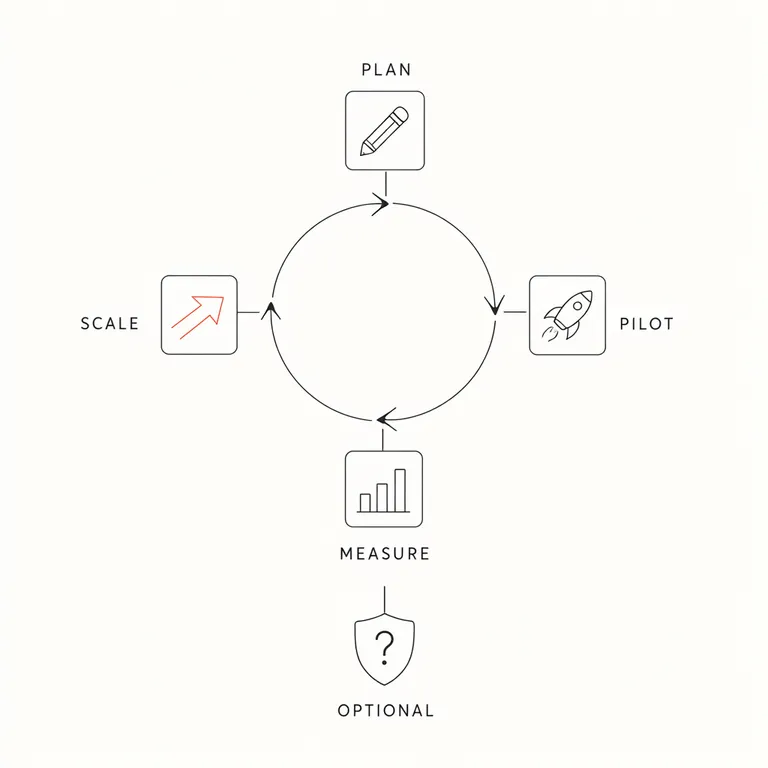
The phases run in sequence, though governance work starts early and never stops. Timings are indicative and depend on size and scope; a large group may run the cycle function by function.
Phase 1: Audit (indicative weeks 1 to 3)
The question: where are we today?
Inventory every AI tool, licence, and API contract, including tools staff expense themselves. Score the six dimensions. Scan the main risks: data leaving the company, contracts with unclear AI terms, and uses that could count as high-risk under the AI Act.
What you need: a single map of AI spend and tools with a keep, cut or consolidate call on each, a maturity baseline, and a short list of risks to close first.
Phase 2: Design (indicative weeks 4 to 6)
The question: what should we become?
Set the target operating model: who owns AI decisions, how use cases are chosen, which workflows change. McKinsey's high performers are far more likely to redesign workflows around AI than to bolt AI onto existing ones; nearly three-quarters of them report doing so, against about a quarter of other respondents (1).
What you need: a prioritised portfolio of use cases, a business case for each, and a KPI tree that links every use case to a business outcome. Insist on stop criteria at this stage. Gartner found that organisations with guidelines for when a pilot should not go ahead were 2.3 times more likely to be among its top performers, and those with rules for ending low-value AI already in production were 2.6 times more likely (3).
Phase 3: Build (indicative weeks 7 to 14)
The question: does it work for us?
Put two or three pilots into real production, not a demo. Set up the data and model stack they need, and start a network of AI champions who carry what works into their teams.
What you need: a first measured read-out against the KPI baseline before scale-up money is committed. If a pilot misses its targets, the stop criteria from Phase 2 apply.
Phase 4: Scale (indicative weeks 15 to 22)
The question: how does it become routine?
Roll out what worked across functions. Redesign roles and train people for them. Gartner found that organisations with explicit plans to redesign roles for a mixed human and AI workforce were 2.4 times more likely to be top performers, yet only 4% had such plans (3). Put controls on model cost and quality, because both will move.
What you need: adoption figures, which are not simply training attendance, token consumption and a cost per task that is tracked over time.
Phase 5: Govern (indicative week 23 onward)
The question: is it safe and paying back?
Make AI part of how the company is run: a board-approved AI policy, a live register of AI systems with an owner for each, AI Act readiness and a quarterly scorecard.
What you need: the scorecard every quarter, with a named owner for each line.
Your role, as the leadership
Three things belong to your own agenda rather than management's.
A scorecard you can read. Ask for a few measures every quarter: adoption (weekly active users), time or cost saved, cost per AI task, quality (share of outputs passing review) and risk incidents, each with a baseline from the audit and a target. Gartner's top performers spend 50% more time working with their CFOs on AI than their peers do, including on who owns ongoing token costs (3). Bring finance in early.
Governance you can show. The EU AI Act sets rules by risk level (5). Its Article 4, as amended by the Digital Omnibus in July 2026, requires providers and deployers of AI systems to take measures to support the AI literacy of their staff and others who use AI on their behalf, without setting a required level for any individual (6). The duty has applied since 2 February 2025, and national authorities can enforce it from 2 August 2026. No certificate is needed; the Commission says an internal record of training will do, and staff who oversee high-risk systems must still be trained for that role (7). The amendment also moved the main high-risk rules to 2 December 2027 for stand-alone systems and 2 August 2028 for AI built into products (6). Treat that as a planning window, not a reason to wait. ISO/IEC 42001 adds a management-system framework for policies, objectives, risk treatment and continual improvement (8). Certification is optional; the structure is useful either way.
Run cost and model volatility. Because AI costs are set at run time, they behave more like a utility bill than a licence (3). Ask that every business case shows cost per task, how it changes with volume, and what happens if the chosen model is repriced, replaced or withdrawn. Contracts should cover data use, price changes and exit.
What to do on Monday
Before the next board or exec meeting, ask management for answers to these questions:
- What AI tools and contracts do we pay for today, and what does each cost?
- Where do we sit on the six dimensions, and which one holds us back most?
- Which three use cases matter most, and what outcome is each meant to move?
- What are our stop criteria for a pilot that does not deliver?
- Who owns the cost of running each AI system?
- Do we have an AI policy, an AI register and a record of AI literacy training?
- Which of our uses might count as high-risk under the AI Act, and are we ready for 2027?
- When will we see the first quarterly AI scorecard?
If the answers are vague, start with Phase 1.
This playbook mirrors how I help organisations in my consulting work, from auditing the AI stack and spend to the people side of the change, the board scorecard, risk checks and advice on when running AI locally makes sense.
References
- Tinkoff, D., Van der Veken, L., Chui, M., & Balakrishnan, T. (2026, August 25). The state of AI in 2026: On the road to ROI. McKinsey & Company. https://www.mckinsey.com/capabilities/quantumblack/our-insights/the-state-of-ai
- S&P Global Market Intelligence. (2025, May 30). Generative AI experiences rapid adoption, but with mixed outcomes: Highlights from VotE: AI & Machine Learning. https://www.spglobal.com/market-intelligence/en/news-insights/research/ai-experiences-rapid-adoption-but-with-mixed-outcomes-highlights-from-vote-ai-machine-learning
- Gartner. (2026, October 19). More AI investment is not creating enough AI ROI. https://www.gartner.com/en/articles/ai-roi
- Stanford Institute for Human-Centered Artificial Intelligence. (2025). The 2025 AI Index report. Stanford University. https://hai.stanford.edu/ai-index/2025-ai-index-report
- Regulation (EU) 2024/1689 of the European Parliament and of the Council of 13 June 2024 laying down harmonised rules on artificial intelligence (Artificial Intelligence Act). (2024). Official Journal of the European Union, L, 2024/1689. https://eur-lex.europa.eu/eli/reg/2024/1689/oj
- Regulation (EU) 2026/1744 of the European Parliament and of the Council of 8 July 2026 amending Regulations (EU) 2024/1689, (EU) 2018/1139 and (EU) 2023/1230 as regards the simplification of the implementation of harmonised rules on artificial intelligence (Digital Omnibus on AI). (2026). Official Journal of the European Union, L, 2026/1744. https://eur-lex.europa.eu/eli/reg/2026/1744/oj
- European Commission. (2026). AI literacy: Questions & answers. Shaping Europe's digital future. https://digital-strategy.ec.europa.eu/en/faqs/ai-literacy-questions-answers
- International Organization for Standardization & International Electrotechnical Commission. (2023). Information technology — Artificial intelligence — Management system (ISO/IEC Standard No. 42001:2023). https://www.iso.org/standard/42001
- Senge, P. M. (1990). The fifth discipline: The art and practice of the learning organization. Doubleday/Currency.
- Ransbotham, S., Khodabandeh, S., Kiron, D., Candelon, F., Chu, M., & LaFountain, B. (2020, October 20). Expanding AI's impact with organizational learning. MIT Sloan Management Review and Boston Consulting Group. https://sloanreview.mit.edu/projects/expanding-ais-impact-with-organizational-learning/