From data to insight: 5 ways to make your business data mean something
Five habits that turn dashboards into decisions.
Everyone who works in an office knows the dashboards and reports: a dozen tiles, a few arrows pointing up or down, a table comparing this month and this year with the last. But working out what is driving the numbers in a tangle of data, finding the insight, and deciding what to do about it is not easy. That's why companies often test data analysis and attribution skills when they interview for management and analytics roles. In this blog, I draw on my many years of data analysis and insight work to share five kinds of value you can get from your marketing and sales data, and the methods behind them.
1. Don't look at data in one dimension
A number on its own doesn't mean anything. It only leaves the report and becomes valuable when it has three things: history (what it looked like before), context (what else was going on at the time) and a decision attached (what you'd do differently depending on the answer).

You've almost certainly been there: profit drops, it's lower than the same period last year and lower than expected, and the panic starts. But has anyone actually analysed what is behind the drop? Is market demand falling? Is it the competition? Is the channel strategy not working? Is it an organic, strategic investment in the brand? And so on. Looking at data in one dimension easily pushes us into a narrow view, where the only move left is to "cut more costs" to save earnings.
2. Know your data
Making decisions based on data depends, above all, on data that is high quality and accurate, and on knowing where it comes from, how it's defined, when to use it and what exceptions it has. Bad data is not a harmless technical detail, either: it costs businesses real money (1). This doesn't mean managers or analysts need to write queries or clean data the way a data engineer does. It means having a clear understanding of the part of the business you work with. In credit product data, for example, the different states (a customer submits an application, a customer accepts an offer, a customer receives a payout) give completely different results.
3. Keep asking why
Many of my colleagues have asked me how to find the driver behind a change, and how to decide what to do next. My usual answer is to keep asking myself questions until the path becomes clear. It's close to the 5 Whys practice from lean management: keep asking why until you get past the symptoms to the root cause (2).
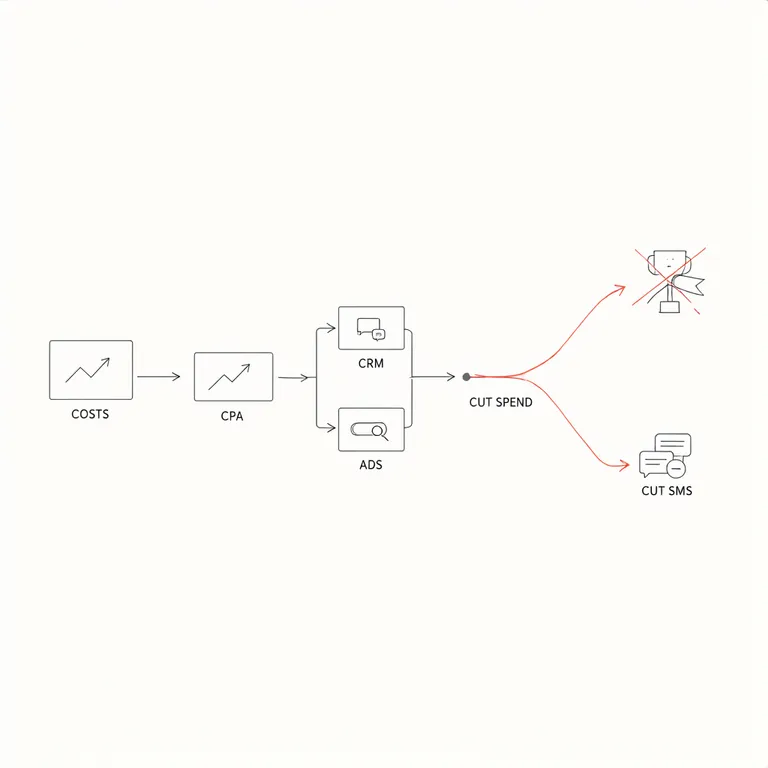
Say you see costs rising week after week. Why? CPA has gone up on the same inflow. Where? In CRM and Google Ads. Why? Google Ads is spending more, but we're also ranking ahead of our competitors, and CRM has been sending more SMS.
Now your choices are much clearer. Do you cut your Google spend and accept the risk of competitors overtaking you? Do you cut the number of text messages CRM sends each week? Making that call is a quick judgement of risk, and a check that it's consistent with your channel strategy.
4. Find trends and segments
Beyond attribution, data can also help us find correlations and trends, so we can move from defence to offence. For example, home appliances sell less the sunnier it is, because people are outside socialising, exercising and travelling, while rainy and snowy days bring more sales. Economists see this at a larger scale too: a Federal Reserve study found that unusual weather plays a modest but significant role in monthly retail sales (3). Or take payday: in the week people get paid, more of them place online orders and the average spend per person goes up. Research based on personal finance app data has found the same pattern, with spending responding clearly when income arrives (4).
Time isn't the only axis. You can also learn your customers' habits. Do more people convert on mobile or on desktop? Are SMS and email clicks higher midweek? How likely is someone who buys product A to also buy product B? And so on.
5. Timing and patience
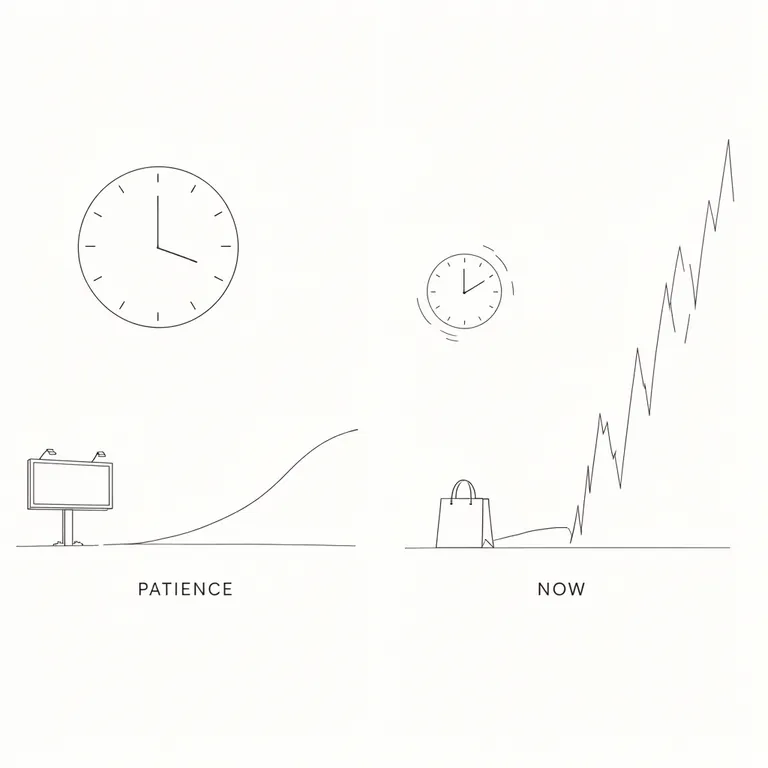
We often use data to judge whether a campaign performed as expected, and the most obvious way is to compare it with what came before. But some data needs time to mature. Say you run an outdoor ad: you can't expect your performance to jump the next day or the next week. You might find some clues in share of search a month later. Les Binet and Peter Field's work for the IPA on short- and long-term marketing is a good reminder that advertising effects play out on different timescales (5). On the other hand, if you run a Black Friday promotion on your e-commerce site, you need to be in something close to war-room mode, because the numbers update in real time. Whether to cut prices, whether to restock, whether to change the strategy: all of these decisions take shape minute by minute in the data.
Putting it together
None of these five points is a formula. Looking beyond one dimension, knowing your data, asking why until you reach the driver, spotting trends and segments, and knowing when to wait and when to move fast all come down to the same thing: judgement, built with patience. Insight rarely shows up the first time you look at a dashboard. It forms over time, as history, context and decisions add up. Give your data that time, and stay sharp for the moments when it needs you right now.
References
- Redman, T. C. (2016, September 22). Bad data costs the U.S. $3 trillion per year. Harvard Business Review. https://hbr.org/2016/09/bad-data-costs-the-u-s-3-trillion-per-year
- Lean Enterprise Institute. (n.d.). 5 Whys. https://www.lean.org/lexicon-terms/5-whys/
- Starr-McCluer, M. (2000). The effects of weather on retail sales (Finance and Economics Discussion Series 2000-8). Board of Governors of the Federal Reserve System. https://www.federalreserve.gov/pubs/feds/2000/200008/200008abs.html
- Olafsson, A., & Pagel, M. (2018). The liquid hand-to-mouth: Evidence from personal finance management software. The Review of Financial Studies, 31(11), 4398–4446. https://doi.org/10.1093/rfs/hhy055
- Binet, L., & Field, P. (2013). The long and the short of it: Balancing short and long-term marketing strategies. Institute of Practitioners in Advertising. https://ipa.co.uk/knowledge/publications-reports/the-long-and-the-short-of-it-balancing-short-and-long-term-marketing-strategies